Combat envelope
Range and detection
Every bar uses the same 20 km scale. Surface detection is a visibility threshold, not a weapon range.
The Netherlands
In 1938, against the backdrop of international tensions, the Dutch Ministry of Defense decided to reinforce its Navy. The projects that appeared in 1939 were, in most respects, similar to the project of German warship Scharnhorst. For economic reasons, it was decided to reduce the size of the new ship. The government was inclined to pursue a project to...
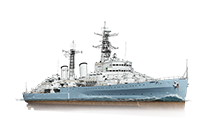
In 1938, against the backdrop of international tensions, the Dutch Ministry of Defense decided to reinforce its Navy. The projects that appeared in 1939 were, in most respects, similar to the project of German warship Scharnhorst. For economic reasons, it was decided to reduce the size of the new ship. The government was inclined to pursue a project to build a 16,000-ton cruiser capable of running at 33 knots and carrying a main battery of 240 or 280 mm guns. In the end, however, to ensure sufficient armor protection, they had to make do with a smaller caliber of 203 mm. If the project had been pursued further, the ship could well have received reinforced AA defenses by the end of World War II.

At a glance
Combat envelope
Every bar uses the same 20 km scale. Surface detection is a visibility threshold, not a weapon range.
Damage comparison
Bars are normalized only against this ship's highest listed hit. They are not salvo damage, expected damage or DPM.
Only positive values supplied by the API are shown.
Surface armament
Damage is the API's published maximum for one shell hit.
Automatic armament
Names, research prices and defaults are reported directly by the API.
Official modernization descriptions and listed purchase prices. Effects still depend on the slot and configuration used in game.
Reduces time to full speed
Cross-nation comparison
Closest same-tier, same-class matches from other nations, ranked by published base statistics.