Combat envelope
Range and detection
Every bar uses the same 25 km scale. Surface detection is a visibility threshold, not a weapon range.
Japan
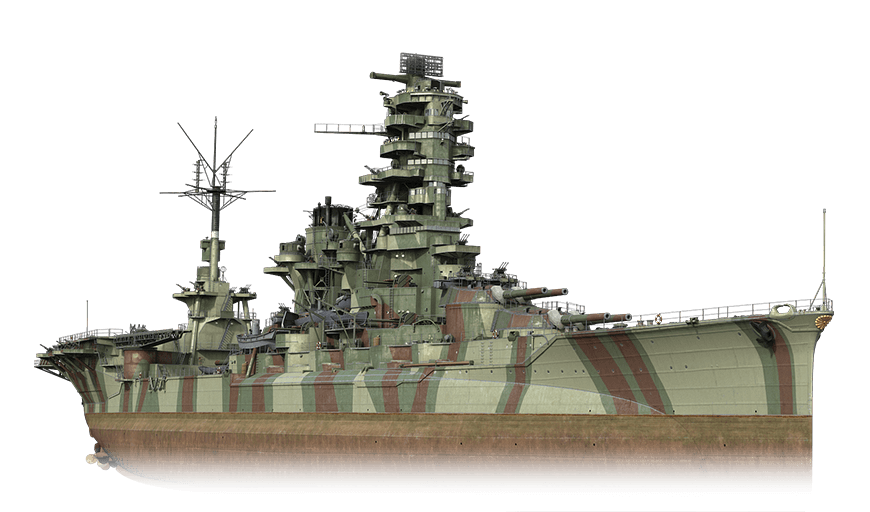
During the development of the Fusō class, military experience and new requirements for fleet management were taken into account, and new positioning of the artillery simplified fire control. By the beginning of World War II, Ise had become obsolete. After Japan suffered significant aircraft carrier losses in the Battle of Midway, Ise was rebuilt as a...
During the development of the Fusō class, military experience and new requirements for fleet management were taken into account, and new positioning of the artillery simplified fire control. By the beginning of World War II, Ise had become obsolete. After Japan suffered significant aircraft carrier losses in the Battle of Midway, Ise was rebuilt as a hybrid battleship-aircraft carrier. Her rear group of turrets was replaced by a flight deck. In 1944, she participated in the Battle of Cape Engaño. In July 1945, Ise was sunk by American bombers near Ondo Seto island.
At a glance
Combat envelope
Every bar uses the same 25 km scale. Surface detection is a visibility threshold, not a weapon range.
Damage comparison
Bars are normalized only against this ship's highest listed hit. They are not salvo damage, expected damage or DPM.
Only positive values supplied by the API are shown.
Surface armament
Damage is the API's published maximum for one shell hit.
Automatic armament
The public API still uses legacy aircraft categories and does not expose every modern carrier payload mechanic. Only fields returned by Wargaming are shown.
Aichi M6A2 Seiran
Names, research prices and defaults are reported directly by the API.
Official modernization descriptions and listed purchase prices. Effects still depend on the slot and configuration used in game.
Reduces time to full speed
Cross-nation comparison
Closest same-tier, same-class matches from other nations, ranked by published base statistics.


